


Being the first partnerships hire at a SaaS company rarely comes with a clear playbook. Expectations are high, definitions are fuzzy, and results are often expected before foundations are even in place.
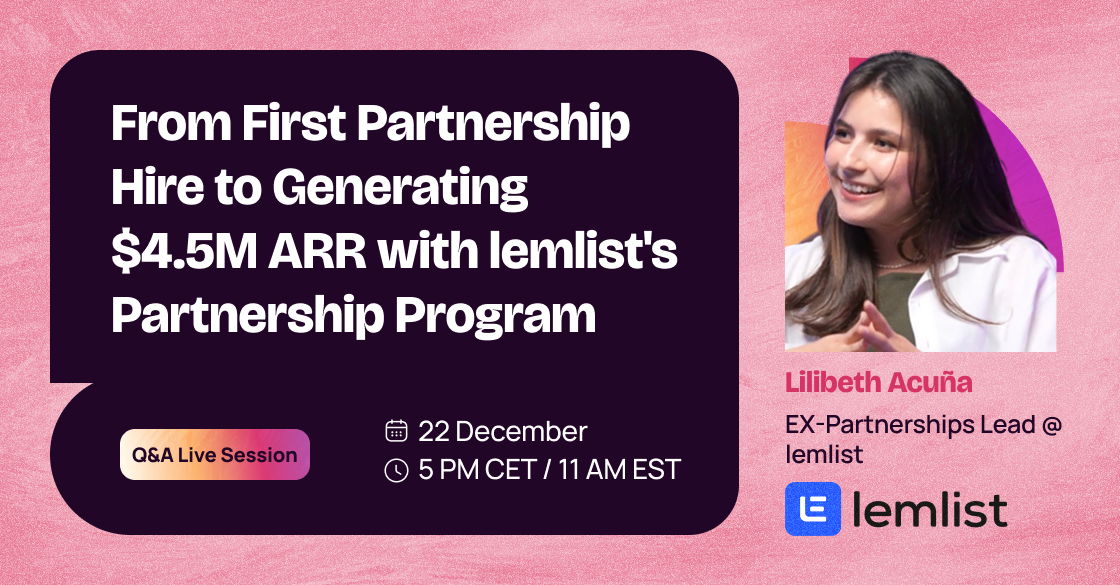
In a recent Kiflo live Q&A, Lilibeth Acuña, former Partnerships Lead at lemlist, walked us through how she built lemlist’s partner program from scratch, and helped turn it into a channel influencing $4.5M in ARR.
What stood out wasn’t just the outcome, but the calm, methodical way she got there. Below are the biggest takeaways from the session.
1. Nobody “Becomes” a Partnerships Manager; You Grow Into It
Lilibeth didn’t start her career in partnerships. She moved through video production, marketing agencies, and tech before landing her first partnerships role at lemlist.
That lack of formal background turned out to be a strength.
Because she didn’t come in with fixed assumptions, she leaned heavily into curiosity—about customers, partners, internal teams, and the market. That learner mindset shaped everything that followed.
Key insight: Not knowing “how it’s supposed to be done” can be an advantage. It forces you to ask better questions and truly understand the ecosystem you’re stepping into.
2. Proving the Concept Starts with Research, not Partner Outreach
One of the biggest early lessons: proving a partnership program doesn’t start with signing partners. It starts with understanding where value is missing today.
Lilibeth shared two critical research tracks:
Customer-first research
Before building a partner program, you need to understand what customers are missing that your product alone doesn’t solve.
She recommended:
- Reviewing support tickets and recurring questions
- Talking directly to customers
- Identifying gaps where partners could add value
Learning from “unofficial” partners
Often, partners already exist—they’re just not formalized yet. Agencies and consultants were already packaging lemlist into their services.
By interviewing around 30 of these early actors, Lilibeth uncovered:
- What they needed to make partnerships worthwhile
- Their non-negotiables
- What would actually motivate them to sell and support the product
That early research became a reference point she came back to for years.
Key insight: If you skip research, you end up building a program based on assumptions. If you do it well, you build something partners actually want to participate in.
3. Partnerships Aren’t a Persona, They’re a Revenue Channel
One of the hardest internal shifts at lemlist was reframing how partnerships were perceived.
Early on, partnerships were seen as:
- A distraction
- Another customer type (agencies)
- Something that might “just work” because the product was good
The turning point came when partnerships were positioned clearly as a revenue channel, not a persona.
That shift unlocked buy-in:
- Investment made more sense
- Expectations became clearer
- Leadership aligned around outcomes instead of activities
Key insight: Partnerships don’t compete with focus; they amplify it when positioned as a growth channel with clear revenue goals.
4. Sales Is Not the Enemy (and Shouldn’t Be an Afterthought)
At lemlist, sales and partnerships were built in parallel—a rare but powerful setup.
Instead of drawing territory lines, the focus was on collaboration:
- Sales flagged potential partners early
- Partners had named sales contacts
- Deals flowed both ways
When questions came up about ownership, Lilibeth was clear:
- The partnership manager owns the long-term relationship
- Sales plays a supporting, deal-focused role
- Any new initiative should be orchestrated through partnerships to maintain consistency
Key insight: The question isn’t “who owns what?” It’s “how do we help each other create more opportunities?”
5. Foundations Work Best When They’re Simple
One of the most practical lessons from the session: simple beats sophisticated, especially early on.
Instead of complex partner tiers or long benefit lists, lemlist focused on one core value proposition:
Helping partners generate revenue.
Every benefit was filtered through that lens.
If it didn’t help partners make money, it didn’t make the cut.
Lilibeth recommends:
- Testing with a small group (20–30 partners max)
- Keeping rules and processes lightweight
- Proving revenue before scaling headcount
Key insight: A simple program you can test is far more valuable than a perfect one you can’t launch.
6. Scaling Means Testing First, Automating Second
When it came time to scale, lemlist followed a clear rule:
Test what you don’t know. Automate what you do.
Some experiments that worked:
- Repeatable co-marketing formats (expert quotes, templates, blog features)
- Lead-sharing flows inside the product
- AI-powered Slack bots trained on internal documentation to support partner enablement
- Partner sourcing from complementary tools and the existing user base
Once something proved effective, it was automated and reused.
Key insight: Scale doesn’t come from doing more things; it comes from repeating what works with less effort.
7. Transparency Builds Stickier Partnerships
Looking back, one thing Lilibeth would lean into even earlier is radical transparency:
- Sharing product direction
- Being honest about timelines and constraints
- Helping partners understand where the company is heading long-term
When partners understand the “why” behind decisions, they invest more deeply in the relationship.
Key insight: Partners don’t just commit to products. They commit to direction.
8. Results Take Time, But Momentum Is Visible Earlier Than You Think
At lemlist, meaningful traction appeared around the one-year mark:
- 6–9% of total revenue influenced by partners
- Enough proof for leadership to double down on the channel
That patience made the difference.
Key insight: Partnerships reward consistency, not urgency. The signal comes before the scale.
Final Takeaway
What made this session powerful wasn’t a single tactic or framework. It was the reminder that strong partner programs are built the same way strong relationships are built:
With curiosity.
With clarity.
And with steady, intentional progress.
For anyone stepping into their first partnerships role, Lilibeth’s journey offers something rare: proof that you don’t need to have all the answers on day one—just the discipline to learn, test, and build with purpose.
