


Most partner programs don't start with a plan. They start with a deal. A partner brings an opportunity, you jump in, it works — and suddenly you've built a motion around something you never designed on purpose.
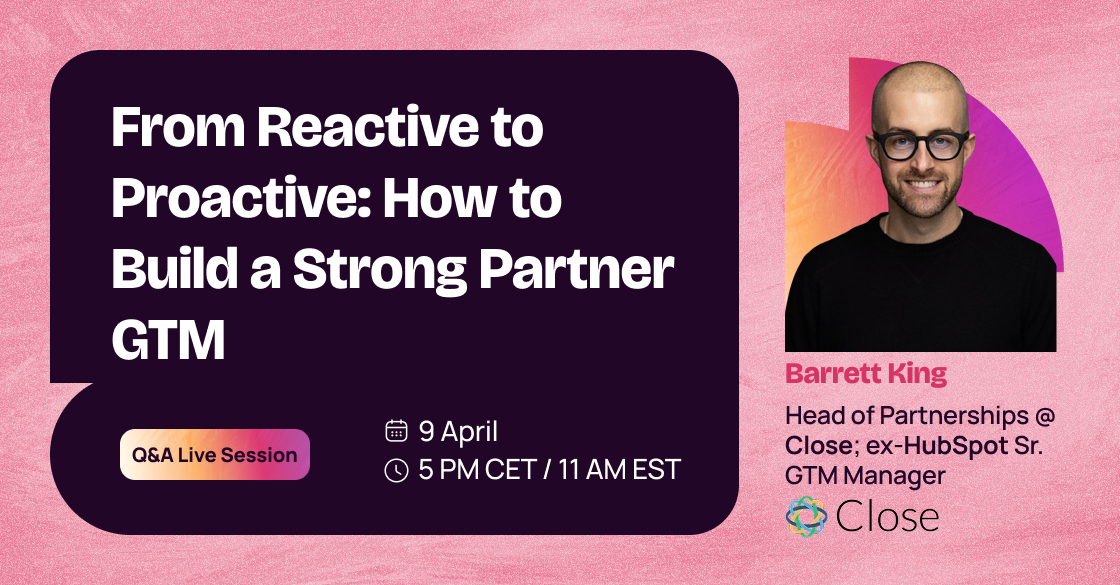
That's the reactive trap. And according to Barrett King, Head of Partnerships at Close and former HubSpot partner leader, it's one of the most common reasons partner programs stall before they ever scale.
In a recent Kiflo live Q&A session, Barrett shared a framework for building a partner GTM that actually generates pipeline — grounded in years of hands-on experience across some of the most recognized names in SaaS.
Here are the biggest takeaways.
1. Find Partner-Market Fit Before You Try to Scale
The most common mistake Barrett sees — across early-stage startups and mature organizations alike — is jumping straight to scale without establishing whether the program is built on anything real.
"There's a question you have to ask before partner-market fit, far before that," Barrett explained. "Do you have product-market fit? Do people buy your software? Do they stick around? Do they spend money?"
Once you can answer yes to those questions, partner-market fit follows a similar logic: observe your customers, and find where they're already working with other businesses.
Are they using complementary software on top of yours? Are they hiring consultants to implement it? Are they working with agencies to get more out of it? Those patterns are your signal. The businesses showing up in your customers' workflows are likely your first partners.
Barrett described three different dynamics he's observed across his career:
- Additive partnerships (HubSpot model): partners that help customers execute more effectively on top of the platform
- Output-based partnerships (Ramp model): partners that take platform data and build services around it
- Combined model (Close): partners that both deliver implementation value and bring new customers
The key is to look at your own customer base with data — not assumptions — and let what you find shape your first partnerships.
"You need to observe where your most successful customers are, go talk to the vendors they're using, figure out that dynamic through learning and questions, and then build an ideology around what a good-fit partner actually looks like."
2. Start Small, Be Patient, and Prove the Behavior
When someone in the session asked how to build a partner GTM from scratch — starting with a single pilot partner in a new region — Barrett's advice was deliberate: don't rush, and don't scale what you haven't proven yet.
"Write down the one specific behavior that partner exhibits," he said. "Do they help unlock an integration? Do they help implement the platform? What's the thing that the customer is saying adds value?"
Then measure it. Track it every week for 30 to 90 days. And when it repeats, don't scale immediately — go find three to five more partners and see if the same behavior shows up again. When it does, that's early momentum.
"Add a partner, increase behavior. Add a partner, increase behavior. And monitor that over many months and years."
This is the pattern Barrett applies regardless of company stage. Do the unscalable work first. Find the micro-partner with one good customer, not the big logo with ten. Define the value in that working relationship, then expand from there.
3. Know the Difference Between Channel and Ecosystem
One of the session's clearest moments came when Barrett drew the line between two terms that are often used interchangeably — and shouldn't be.
Channel is the traditional model: partners that bring net new revenue. It's direct, transactional, and measurable. It worked well for the hyperscalers — Microsoft, Salesforce, HubSpot — and it still works for many programs today.
Ecosystem is something broader. Ecosystem, as Barrett describes it, is "the surround sound of your business." It includes:
- Integration partners extending platform value
- Marketplaces increasing distribution and reach
- Review platforms like G2 that build legitimacy and awareness
- Implementation partners who improve retention and product usage
"To build a successful organization today and have any element of contribution from other companies, you need to think holistically around the different places partnerships exist," Barrett said.
He references analyst Jay McBain of Canalys, who has written extensively about what he calls the "decade of the ecosystem" — the idea that channel alone is no longer sufficient as a partner strategy for most modern SaaS businesses.
The practical implication: if you're only thinking about who can bring you net new leads, you're leaving a significant portion of partner value on the table.
4. Build the Right Foundations (Before You Build a Program)
Barrett is direct on this point: don't try to build a partner program. Build partnerships.
"A partner program is big and messy and annoying and hard," he said. "Build real relationships, real business outcomes together. That's what you should be thinking about."
For early-stage programs, this means:
Hire builders first. Your first two to four partnership hires need to be entrepreneurs — people who can both tell the story and document the process, both develop relationships and measure outcomes. They shouldn't just be practitioners. They need to be creators.
Document everything. Record partner conversations. Capture the patterns. Use tools like Notion or Google Docs to build a living foundation of what works, what doesn't, and what your partners are actually saying. Barrett mentioned using Claude on the backend to analyze partner call patterns — not to share externally, but to identify gaps and improve the program over time.
Resist the temptation to build tiers and directories too early. "You gotta have a few partners first. You gotta have a foundation that works." Tiers, portals, and directories come later — when you have something to organize.
Think about doing more with less. Barrett posed a genuine challenge to the audience: "Could you build a $100 million revenue stream with 30 people? I think now you can." AI and modern tooling make it possible to run a lean, high-impact partner operation — but only if you're investing in the right foundations first.
5. Partner Activation Is Your North Star Metric
This was arguably the most actionable point of the session, and one Barrett returned to multiple times throughout the conversation.
"I always love when I talk to partner leaders and they'll go like, 'we have 957 billion partners.' And I'm always like, yeah, sure. How many of them actually do the thing you want? And they're like, 7."
The number of partners in a program is a vanity metric. What actually matters is activation — defined by Barrett as time to first transaction: a partner bringing a deal or a net new customer within the first 60 to 90 days of the partnership.
Consistent activation means doing it again in the next 60 to 90 days. Two activations in a row? You're on your way.
Barrett's framework for activation as a North Star metric:
- Define it clearly: what specific behavior counts as activation for your program?
- Make it measurable and repeatable, not subjective
- Track it at every funnel review, every month
- If activation isn't steady or trending up, treat it as a problem — even if you're hitting other numbers
"Partnerships, just like sales, just like running business in general, is a game of math. It doesn't need to be arbitrary. Activation is the success metric you should live and die by."
The practical implication for program reviews: fewer partners with higher activation rates is always preferable to a large partner count with low activity.
Bonus: How to Handle a Leadership Team That's Not Partner-First
One audience member raised a challenge that resonated across the room: what do you do when 43% of ARR is already coming from partners, but leadership still isn't bought in?
Barrett's response: make the correlation visible, and do it repeatedly.
- Pull customer testimonials from partner-influenced deals. Get them on record saying the partner was why they bought.
- Track partner attach rate and compare the LTV and CAC of partner deals vs. non-partner deals
- Send a monthly internal partner wins email — to the whole company, not just the leadership team
- Show up to team meetings, all-hands sessions, and executive reviews with partner data in hand
"Sunlight is the best disinfectant," Barrett said. "You should be silly about it. Just make it a thing you talk about. Because mostly process and awareness come from repetition — and you're going to get feedback on the gaps."
If your partners are driving nearly half of your revenue, the problem isn't the program. It's the story being told about the program.
Key Takeaways
- Partner-market fit comes from observing your most successful customers and understanding the businesses already in their ecosystem
- Start with one behavior. Write it down, track it, prove it repeats, then scale it
- Channel is not the same as ecosystem. Build for the full surround sound, not just net new leads
- Don't build a partner program. Build partnerships — with the right first hires, documentation, and patience
- Activation is your North Star metric. Time to first transaction, tracked consistently, is the clearest signal of a healthy program
- Visibility sells internally. Document wins, share them broadly, and make the partner program impossible to ignore
