


Running partnerships often feels like assembling a system you hope will eventually produce results.
You define the structure, introduce processes, and put tools in place, tiers, portals, commission plans, expecting that, over time, partners will engage and momentum will follow. But more often than not, what you get is partial adoption, inconsistent activity, and a lingering question: is this really working?
HeyReach faced that same reality early on. But instead of refining the traditional model, they stepped away from it entirely.
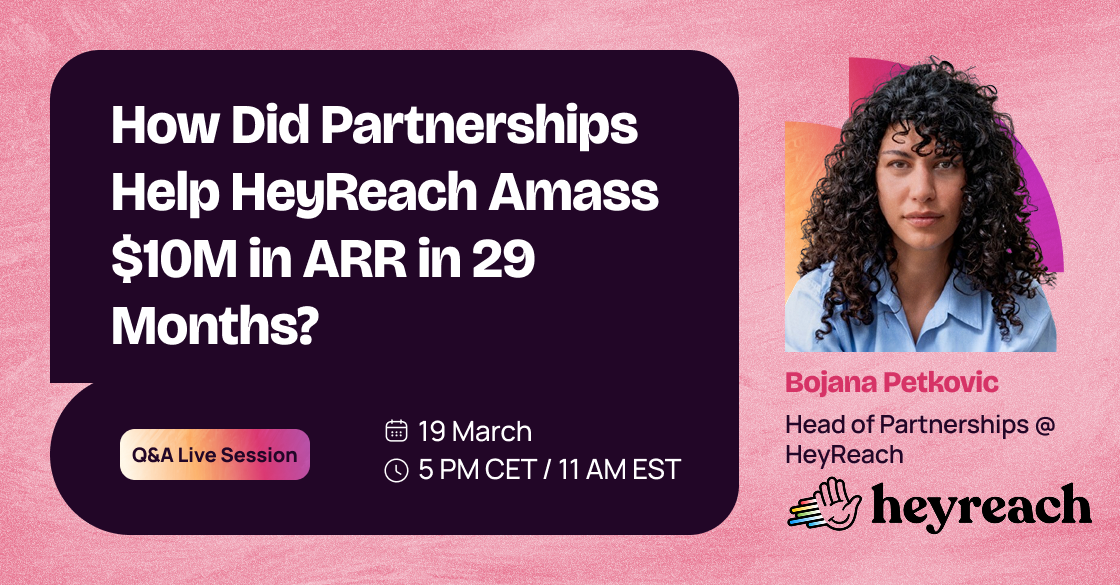
In a recent Q&A with the Kiflo community, Bojana Petkovic, Head of Partnerships at HeyReach, shared how they built an ecosystem, not just a partner program, that now drives more than 50% of the company’s growth and played a key role in reaching $10M in ARR in just 29 months.
What stands out in their approach is not a single tactic, but a different way of thinking about partnerships altogether.
Start Where the Energy Already Exists
Rather than beginning with recruitment or structure, HeyReach paid close attention to what was already happening around their product.
Users were sharing results. They were posting content. Some had already built credibility and small audiences in the GTM space. In many companies, this kind of activity is seen as a nice bonus. At HeyReach, it became the foundation.
Instead of asking, “How do we bring in partners?”, they asked, “Who is already behaving like one?”
That shift led them to their first group of experts—power users who were not only familiar with the product, but already advocating for it in public. These early partners weren’t onboarded into a fixed program. They were invited to help shape it.
The first 19 experts received a level of attention that would not scale later on: direct access to the team, tailored support, and a genuine role in co-creating the ecosystem. This wasn’t about efficiency. It was about getting the experience right before expanding it.
And that early investment paid off in a way that structured programs often struggle to replicate—it created momentum.
Build for Attention, Not Just Participation
One of the more subtle but important insights Bojana shared is that partnerships don’t just compete with other programs—they compete for attention.
Most of HeyReach’s potential partners were already involved in other ecosystems. They were working with tools like Clay or Instantly, already allocating time and energy elsewhere. Launching another standard partner program would have meant asking them to do more, without offering something meaningfully different.
So HeyReach focused on reducing friction and increasing relevance.
They made participation feel natural. They avoided rigid structures early on. And importantly, they designed the experience around how these experts already worked—creating content, engaging audiences, and helping clients succeed.
Instead of forcing a new behavior, they amplified an existing one.
Momentum Comes From Credibility
Drawing from her background in influencer marketing, Bojana applied a principle that translates surprisingly well into partnerships: start with people others already pay attention to.
The first experts weren’t chosen purely for their ability to drive revenue. They were chosen for their visibility and credibility in the space. Their involvement signaled that HeyReach was worth paying attention to.
That signal created curiosity. Curiosity turned into applications. And soon, the team found themselves managing a growing waiting list instead of struggling to recruit.
It’s a reminder that in ecosystems, growth is often less about pushing outward and more about creating pull.
Focus on What You Can Control
Partnership leaders are often measured on revenue, but revenue in partnerships is rarely linear or immediate. It comes from a combination of actions, relationships, and timing—many of which are outside your direct control.
HeyReach approached this differently by focusing on inputs rather than outputs.
Instead of trying to directly optimize for revenue, they invested in the elements that make revenue more likely:
- creating a smooth, low-friction experience for partners
- maintaining regular, meaningful conversations
- providing useful content and support without over-controlling how it’s used
One example stands out. When onboarding calls were temporarily removed to streamline operations, engagement dropped—and so did partner-driven results. Reintroducing those calls restored performance.
It’s a simple lesson, but an important one: small changes in partner experience can have a disproportionate impact on outcomes.
Make Partners the Center of the Story
In many partner programs, the company remains at the center, and partners orbit around it.
HeyReach flipped that dynamic.
Their experts are positioned as the main actors—the ones building authority, leading conversations, and showcasing results. The company’s role is to support that visibility, not dominate it.
This shows up clearly in how they approach collaboration. Whether it’s co-selling opportunities, co-marketing efforts, or events, the focus is on helping partners grow their own business and reputation.
Because when partners succeed independently, they bring that success back into the ecosystem.
Events Turn Digital Relationships Into Real Growth
While much of the ecosystem operates online, HeyReach places a strong emphasis on in-person interaction.
They’ve found that relationships built through content and messages gain a different level of depth when people meet face-to-face. Events—whether executive dinners, local meetups, or larger gatherings—act as a bridge between awareness and real pipeline.
At the same time, they don’t treat all events equally. Each format serves a purpose, and understanding that distinction allows them to invest more intentionally:
- In-person events are where relationships deepen and deals begin to take shape
- Webinars are better suited for education, product updates, and structured knowledge sharing
What ties both formats together is that they are built around partners. Experts lead the conversation, share their workflows, and demonstrate real use cases, while HeyReach supports the structure behind the scenes.
Turn Interest Into a Growth Path
As the ecosystem grew, so did the number of people who wanted to be part of it—but weren’t quite there yet.
Instead of filtering them out, HeyReach created a second layer: a creator program designed for those still building their audience and expertise.
This added an important dimension to the ecosystem. It became not just a network, but a progression.
Creators receive guidance on how to grow—how to share content, how to position themselves, how to build authority. Over time, they can evolve into experts, strengthening the ecosystem from within.
It’s a simple idea, but a powerful one: don’t just recruit finished partners. Help create them.
The Bigger Shift
What HeyReach built is not just a successful partner motion. It reflects a broader shift in how partnerships are evolving.
Less emphasis on rigid structures. More emphasis on relationships and shared growth.
Less control over every action. More trust in the people who represent your product in the market.
And perhaps most importantly, a move away from asking, “How do we get partners to drive our growth?” toward a more balanced question:
“How do we grow together?”
That mindset is what turns a program into an ecosystem, and, over time, an ecosystem into a meaningful revenue engine.
