

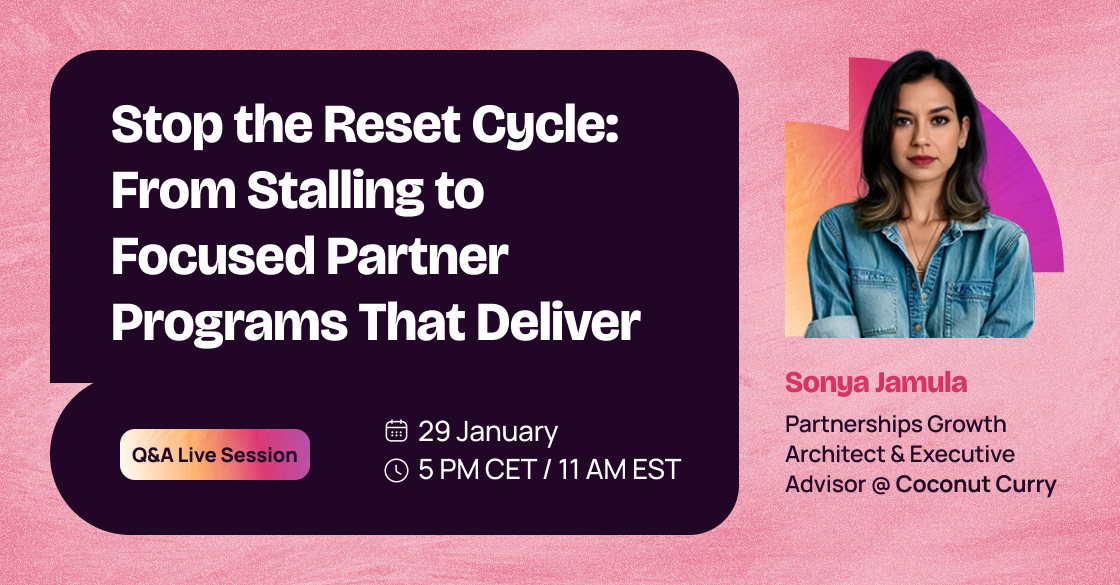

Partner programs rarely fail because teams aren’t trying. They fail because they keep getting reset.
In Kiflo’s first live Q&A of 2026, Sonya Jamula, Partnerships Growth Architect & Executive Advisor and former VP of Partnerships at Gusto, joined us to unpack why so many partner programs stall, even at strong companies, and what it actually takes to build programs that compound instead of restarting every quarter.
What followed was an honest, tactical conversation rooted in operator experience, not theory. Below are the biggest highlights from the session.
1. The Core Problem: Treating Partners Like Extra AEs
One of the clearest themes from the session was: most leadership teams unconsciously expect partner motions to behave like direct sales.
As Sonya put it, many companies launch partnerships and then manage them as if they’ve just added another sales rep, expecting fast results, predictable forecasting, and immediate revenue impact. But indirect motions don’t work that way .
With partners, you’re asking another company to:
- Learn your product and story
- Prioritize your solution among many others
- Fit into their own workflows and incentives
That takes more upfront design, more enablement, and more patience than direct sales.
When companies apply direct-sales muscle memory, quotas, timelines, forecasting, to partners, the result is unrealistic targets, broken trust, and inevitable resets.
2. What a “Sane” Partner Timeline Actually Looks Like
A major reset trigger is timeline mismatch. Sonya outlined a realistic framework for partner performance that many teams never get aligned on:
0–90 days: Design and activation
- Define the partner motion
- Enable partner teams
- Run joint activities
- Get to a first shared customer win
If nothing meaningful happens in the first 90 days, that partnership is already at risk of stalling.
90–180 days: Signal
- Partner-sourced or partner-influenced opportunities appear in the CRM
- Early deal patterns emerge
- Teams learn what’s repeatable, and what’s not
6–12 months: Forecastability
- Consistent pipeline from a small set of partners
- Clear pattern recognition
- Early compounding effects
Expecting a fully scaled channel in two quarters isn’t a partnership problem, it’s a planning problem .
3. Leading Indicators Matter More Than You Think
One of the most practical parts of the session focused on metrics.
Sonya emphasized that signed partners are not a meaningful success metric. What matters is activation.
Some of the leading indicators she watches closely:
- How many partners are actively enabled
- Whether joint activities are actually happening
- How many opportunities have a partner attached in the CRM
- How many sellers and CS teams are using partner plays
These signals tell you whether future revenue is even possible, long before lagging indicators like ARR appear .
When leaders can see both leading and lagging indicators clearly, partnerships stop feeling “soft” and start behaving like a revenue motion that can be inspected, tuned, and scaled.
4. Focus Beats Logos (Every Time)
Another major contributor to stalled programs is spreading effort too thin.
Instead of chasing dozens of “strategic” logos, Sonya recommends choosing a small number of lighthouse partners—partners you intentionally overinvest in to prove a motion that can later be repeated.
A true lighthouse partner:
- Sits directly on top of your ICP
- Gives you market signal and visibility
- Helps you validate a repeatable motion
This requires discipline. It also requires saying no—to shiny logos, board intros, and opportunistic partnerships that don’t fit the motion you’re trying to prove.
Without this focus, teams end up with what Sonya called a “logo graveyard”: partners listed on the website, but never activated .
5. Under-Resourcing Is Often the Silent Killer
Many partner programs are set up to fail before they begin.
Common patterns Sonya sees:
- One partnerships person supporting dozens of partners
- No PMM or enablement support
- No SE capacity for joint deals
- AE incentives that make partner deals harder, not easier
“Enough” resourcing doesn’t mean large teams—but it does mean having a baseline:
- Enablement and/or PMM support
- Clear CRM attribution and routing
- Incentives that don’t punish sales for using partners
If partner deals create friction, sales teams will avoid them—no matter how strategic partnerships are labeled .
6. The Founder’s Role in Stopping the Reset Cycle
One of the most impactful moments came when Sonya addressed the role of founders and executives.
Partner programs cannot succeed if ownership sits solely with the partnerships team.
Founders play a critical role by:
- Setting a clear mandate for how partnerships contribute to growth
- Backing focus decisions—even when shiny opportunities appear
- Aligning incentives across sales, marketing, product, and CS
- Protecting the program from constant priority shifts
Without that protection, resets become inevitable, and compounding never gets a chance to happen .
Final Thought: Compounding Requires Consistency
The biggest takeaway from the session was simple, but powerful: Partner programs don’t compound because teams move faster. They compound because teams stay focused long enough for the motion to work.
That means realistic timelines, fewer partners, clearer metrics, and the right level of support, combined with leadership alignment and patience.
