

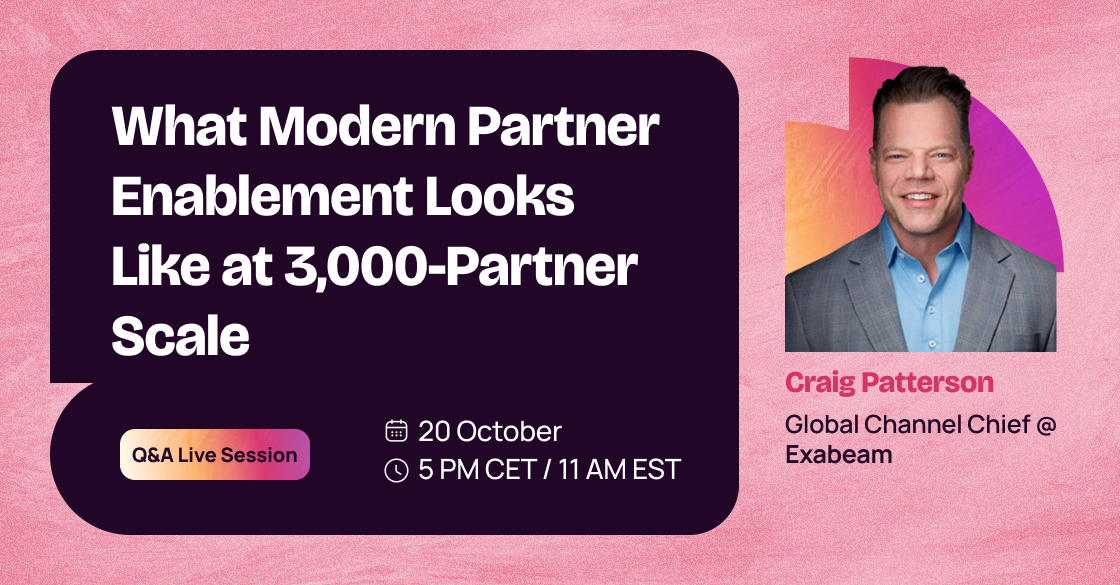

Modern partner enablement at scale means moving from content partners can access to support that makes them better sellers. In our latest Kiflo Q&A, Craig Patterson, Global Channel Chief at Exabeam, explained how his team supports more than 3,000 partners with a small channel team: tying incentives to enablement, measuring outcomes instead of completions, and using an AI layer called Sherpa to extend the reach of channel managers without replacing them.
Craig has spent more than 20 years building and scaling partner ecosystems, including helping grow a channel business from $100M to more than $1B. Here are the biggest takeaways from the session.
A certificate tells you who finished the course, not who can sell
Most enablement programs follow the same pattern: partners log in to a learning management system, watch a video, take a quiz, and get certified. Craig was blunt about how that plays out in practice. Busy partners turn the volume down, skip to the end, and when the quiz arrives, they paste the questions into AI.
The result is what he calls a content museum. Resources are available, but they don't raise partner competency, and in a market where products change every quarter, static content goes out of date quickly.
Craig pointed to a Canalys survey of roughly 25,000 partners, which he said found that 82% did not feel ready for the AI services wave, with enablement as the top reason. What partners asked for instead was more hands-on work: workshops, demos, and practice, rather than more PDFs.
The measurement problem follows from this. Certification counts show participation, but they don't tell you which partner gives the best demo or moves deals forward fastest.
Partners want a path to profitability, and enablement can be part of it
When Exabeam rebuilt its partner program, it surveyed partners and studied market trends. The common thread was value, and the first part of value is a clear path to making money.
Exabeam connected that directly to enablement. Partners who complete the full training journey and earn the highest pre-sales and post-sales certifications unlock an additional discount. The best economics go to the partners who invest in getting better.
The second part is fit. A distributor, a VAR, and an MSSP delivering deployment services need different enablement, and so do partners in different regions where market adoption varies. As Craig put it, enablement is not one size fits all.
Focus your channel managers, automate the rest
Asked which partners should get enablement, Craig described Exabeam's tiered model. The top 25 partners get dedicated Channel Account Managers, annual business planning, and quarterly business reviews. The rest of the ecosystem is supported through systems built to scale.
The goal is not to enable 25 partners and ignore the others. It's to give CAMs time for what matters most, building relationships with high-value partners, while automation handles the administrative work and basic questions. Craig was clear that this is not a strategy to replace people.
Inside Sherpa: Exabeam's always-on enablement layer
With 3,000 partners spread across almost every country and a small team, Craig said there was no way to support the ecosystem at scale with people alone. That became the starting point for Sherpa, which covers three use cases.
An always-on virtual CAM
Partners can ask questions at any time through Slack, Teams, or the partner portal, covering products, the partner program, services, ICP, and use cases. Answers come from a knowledge base on everything related to working with Exabeam. Craig said more than 1,000 partners use it, and the team monitors incoming questions: when one can't be answered well, they define the answer and add it back to the knowledge base, so the system keeps learning.
A learning path built around practice
Partners pick a topic, learn it, then practice it in simulated conversations. A partner focused on healthcare, for example, can rehearse a pitch with a simulated healthcare CISO and get feedback on how to position the message better for that vertical. The learning path leads to certification, and it runs in local languages, so a partner in Japan can learn in Japanese and a partner in the Middle East in Arabic, with no travel required.
A virtual coach on live calls
The third use case moves from practice to real conversations. Partners can invite Sherpa to calls with prospects, where it provides coaching in the background, such as suggesting a relevant use case when a prospect raises an objection. Craig called this the boldest part of the system, and tied it to a broader point: people running partner ecosystems often have a short runway to prove results, so the strategy has to be ambitious.
Buyers arrive already informed, and partners need to meet them there
Craig, who recently took on marketing at Exabeam as well, described a shift in how buyers reach vendors. By his estimate, around 85% of the buying journey happens in a dark phase, where buyers identify their problem, assess solutions, and validate options through research and AI search without speaking to anyone.
When they emerge, they often call a partner to validate what they've already concluded. They don't need a company overview. They need to get to technical validation quickly. That's where enablement pays off: Sherpa handles the fundamentals so partners and CAMs can focus on the technical conversation. In Craig's view, the era of chasing MQLs is over, and showing up in AI search matters more.
Measure enablement by commercial outcomes
Craig's starting point for metrics is the company's operating plan: more bookings, higher conversion rates, and faster movement through sales stages. Enablement metrics should tie back to those outcomes. Exabeam looks at:
- Time to first deal: how quickly newly recruited partners close their first opportunity
- Sales velocity: which partners, in which regions, move through sales stages fastest
- Where partners get stuck: which stage slows each partner down
That last metric drives what Craig calls micro enablement. If a partner is strong in healthcare but stalls at the negotiation stage, Exabeam targets enablement at negotiation. And because healthcare deals reliably hit a third-party compliance review later on, the partner gets prepared for it before it arrives.
The same data shapes how opportunities are routed. Knowing which partners specialize in which verticals and segments, and which convert fastest, lets Exabeam put each opportunity in the hands of the partner most likely to win it.
The takeaway
Craig closed with an optimistic view: partnerships are the operating model for scale, and in cybersecurity, he estimates more than 90% of business flows through partners. The teams that win will be the ones that stop measuring enablement by what partners complete and start measuring it by how partners perform in front of customers.
That shift, from partner activity to partner revenue, is the same one we see across the partnership teams we work with at Kiflo. An ecosystem is only worth what it does for pipeline.
