

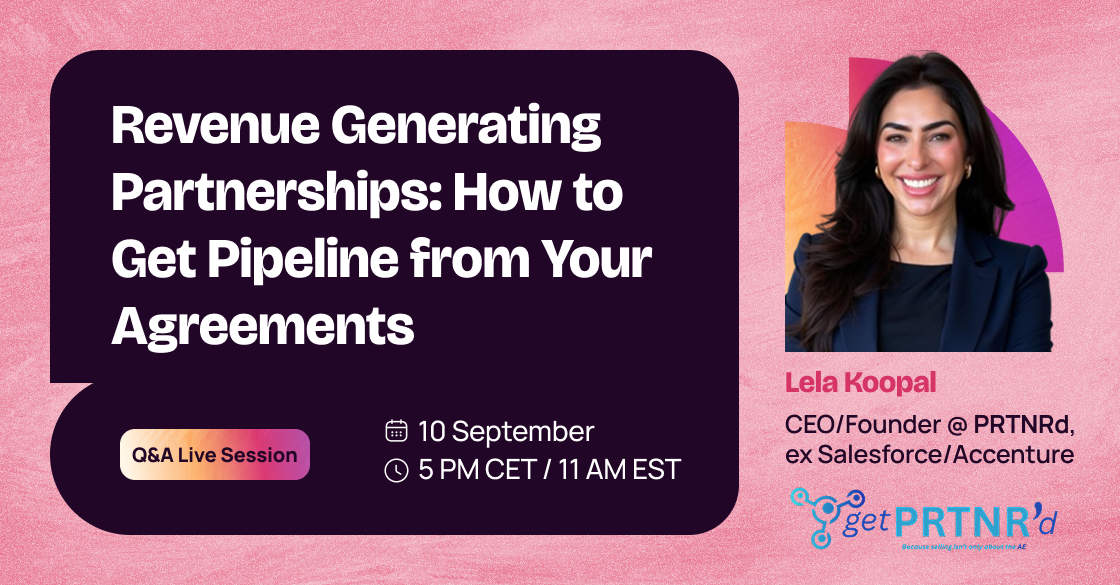

Most partnerships teams know the pattern well: you sign the agreement, add the partner to the PRM, and then... maybe 15-20% of those partnerships ever bring in real revenue. In a recent live Q&A, Lela Koopal, CEO and Co-Founder of PRTNRd, who spent over a decade building ecosystems at Salesforce and Accenture, broke down exactly why that happens and what to do about it. Here are the biggest takeaways.
Revenue is a lagging indicator, not a diagnostic one
The instinct is to judge a partnership by the revenue it produces. But by the time revenue shows up, it's already too late to course-correct. Lela argued that partner-sourced revenue is the goal, but it's the wrong metric to use when deciding whether a partnership has potential in its first year. Instead, look at leading indicators: seller activation, qualified conversations, account mapping, and opportunity creation and conversion. If a partner is generating opportunities but nothing is closing, that's a sales motion problem, not a lead problem, and it needs a different fix.
There's also a real window here. Momentum with a new partner tends to pick up or fall off within the first six months. That's the stretch where a partnership either builds real traction or quietly stalls.
Commercial viability comes down to go-to-market strength
Signing an agreement doesn't mean a partner has a real go-to-market of its own. Many smaller partners, especially companies under $50 million in revenue, are still founder-led and figuring things out. A partner's commercial viability rests on a few concrete factors: customer overlap (not necessarily the same customers today, but the same target accounts), complementary rather than competitive capabilities, and shared economics that hold up once teams actually get into a sales cycle.
Go-to-market signals, in Lela's view, are visible from the start. You don't need to wait 60 or 90 days to find out if a partner has one. That's a helpful shortcut when evaluating who's worth investing energy in early versus who needs to be tested first.
Certification and revenue-gating are two different questions
There's a common instinct to gate partners behind heavier requirements: technical certification, minimum prospect counts, lengthy contracts. Lela separated these into distinct issues. Technical certification matters when a partner is delivering or representing your product directly, since consistency there is table stakes. But requiring a partner to prove revenue before you invest in them is a different, riskier bet. For larger ecosystems managing hundreds of partners, some gatekeeping is necessary just to stay sane. But for most teams, spotting the early signals of a promising partner and actively helping them succeed leaves less revenue on the table than waiting for them to prove themselves first.
Heavy onboarding requirements, like lengthy contracts or steep prospect quotas, can work if you're a brand partners will jump through hoops for regardless. For everyone else, that bar tends to just shrink the pool of partners willing to engage.
Repeatability is the throughline of every viable partnership
A single massive deal or one anchor customer doesn't make a partnership commercially viable. What does is finding something repeatable. That applies even to services partnerships, which often get treated as too custom to standardize. If you've solved a specific problem for a customer once, you've likely solved a version of it multiple times, and that pattern is what should get packaged and sold, not the one-off scope.
The advice: identify one ICP, one problem, one solution, and a quantified outcome, then build your positioning around that story. Buyers don't care about the technical build; they care about the business problem you solved and the result you delivered. A partner (or a partnership) that can't articulate that clearly is going to struggle to scale.
Not all partnership motions are created equal
Referral and resale motions are the easiest to stand up, but they come with real limits, particularly for SaaS and AI products that are already fairly abstract to buyers. When a solution requires complex configuration and multiple moving parts, customers don't want to reconcile separate invoices and separate vendors. They want one outcome. That's where true co-sell and joint go-to-market motions tend to outperform simpler referral or resale setups, especially for more complex, technical products.
On revenue-sharing specifically: it's a structure that tends to align partners around their own commission rather than the best outcome for the shared customer, which can undercut the partnership's long-term scalability.
Defensive and pipeline partnerships should coexist
Partnerships aren't just about new pipeline. Retention matters too, but it works best as a byproduct of a partner's ongoing involvement (driving usage, upsells, and new use cases) rather than as the core justification for the relationship. The strongest partnerships tend to do both: the primary company identifies the accounts a partner can access, and the partner owns the long-term relationship, consumption, and expansion from there.
The bottom line
Across every topic, one theme repeated: revenue doesn't happen because a partnership exists. It happens because of a repeatable, well-scoped motion tracked against leading indicators, built with the right partners, and structured around a shared outcome. Getting from signed agreement to real pipeline isn't about adding more partners. It's about being deliberate with the ones you have.
