


Account Mapping
Account mapping is the process of identifying the customers, prospects, and target accounts that overlap across your company and its partners. It helps partner and sales teams determine where a partner already has a useful relationship, which accounts are worth pursuing together, and what action should happen next.
For partner teams, account mapping is not simply about producing a list of matching companies. Its value comes from turning overlap into warm introductions, referrals, co-selling opportunities, and partner-sourced or partner-influenced pipeline. When account data, partner context, and sales activity are connected, teams can prioritize the partners and accounts most likely to produce revenue.
This guide covers what account mapping means, how the process works end-to-end, why it matters for partner and sales teams, how it differs from related concepts like account planning and co-selling, where it commonly breaks down, and how to measure whether it's actually working.
What Is Account Mapping?
Account mapping means two related things in B2B: identifying the people and relationships inside a single target account, and identifying where a company's accounts overlap with a partner's accounts. This guide focuses on the second meaning, since that's where partner and sales teams collaborate to turn overlap into revenue.
What does account mapping mean in B2B sales?
In a sales context, account mapping usually refers to mapping the organization inside a single target account: identifying decision-makers, champions, day-to-day users, influencers, and blockers, understanding how they relate to each other and to the buying decision, and planning how to engage and progress the account. This internal version of account mapping is closely related to stakeholder mapping and account planning, both defined below.
What is partner account mapping?
Partner account mapping compares a company's target accounts, customers, prospects, and open opportunities against a partner's account data to find overlap. It answers questions like: does this partner already sell to, or have a relationship with, an account on our target list? Does a shared customer create expansion potential for either company? Is there a prospect where a partner's credibility could open a door that's currently closed? The output is a prioritized set of overlap accounts worth acting on, not just a spreadsheet of matching company names.
What does an account map show?
A well-built account map typically surfaces:
- Shared customers between a company and a partner
- Shared prospects or accounts both parties are separately pursuing
- Partner customers that match a company's ideal customer profile or target-account list
- Open opportunities where a partner might have relevant influence
- Expansion and whitespace opportunities inside existing accounts
- Potential warm paths into an account through an existing partner relationship
An account map identifies where an opportunity may exist. It does not, by itself, qualify the opportunity or determine what the partner and sales teams should do next. That qualification and action step is where most of this guide's value sits, and it's covered in the complete breakdown of the account mapping process.
How Does Partner Account Mapping Work?
Partner account mapping works as a six-step process: define target accounts, compare them against partner data, qualify the overlap, choose an action, assign ownership, and track the result through to revenue.
1. Define the accounts you want to pursue
Start with the accounts that matter most: your ideal customer profile, an active target-account list, open opportunities already in motion, existing customers with expansion potential, and any relevant geographic, industry, company-size, or product filters. Mapping every possible account before narrowing to a priority list wastes effort on overlap nobody will act on.
2. Map those accounts against the partner ecosystem
Compare the selected accounts against partner customers, partner prospects, existing partner relationships, relevant integrations or services, and overall partner coverage across your priority accounts. This is the step most people picture when they hear "account mapping," but on its own it only produces a list of matches.
3. Qualify the overlap
Not every match is useful. Qualifying overlap means assessing the strength of the partner's relationship with the account, how well the account fits your ideal customer profile, the opportunity's stage, how complementary the two companies actually are, timing and buying signals, whether the partner is willing to collaborate, and the potential value to the customer. A large list of weak matches is worth less than a short list of strong ones, and treating every match as equally promising is one of the fastest ways to burn a partner's goodwill on an introduction that goes nowhere.
4. Choose the appropriate account play
Once an overlap is qualified, the team picks an action: a warm introduction, a partner referral, joint outreach, co-selling on an active deal, an expansion or cross-sell motion, partner influence on an existing opportunity, or, in some cases, no action at all when the overlap turns out to be weak or irrelevant. Choosing "no action" deliberately is still a useful outcome. It stops a partner manager's time from going toward relationships that were never going to convert, and it keeps the account list focused on plays worth pursuing.
5. Assign owners and next actions
Every account play needs a name attached to it. Responsibility typically sits with some combination of the partner manager, the account executive, a partner representative, RevOps or Partner RevOps, and marketing when an account-based campaign is involved. Each selected account should have an owner, a next action, a deadline, a partner contact, and a status that's visible to everyone involved, not just the person who found the overlap.
6. Track the account through pipeline and revenue
The final step connects the action back to a result: introduction and action status, deal registration, whether the partner is recorded as a source or an influence on the opportunity, opportunity progression, closed revenue, and commissions or attribution where applicable. Without this step, account mapping stays an activity nobody can measure.
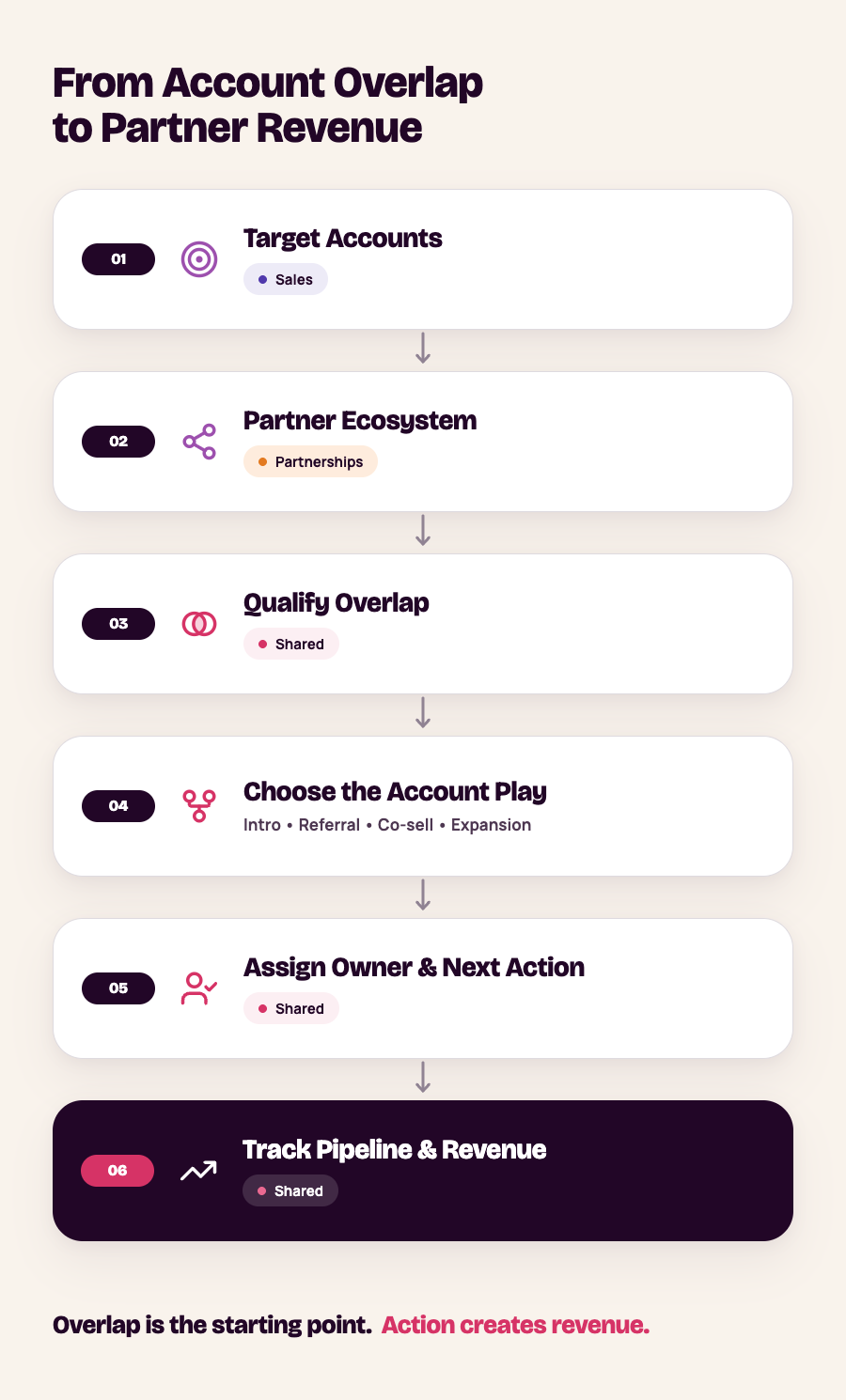
The workflow in one line: Target accounts, then partner overlap, then a qualified opportunity, then a warm introduction or co-sell, then pipeline, then revenue. Overlap is an input to this chain, not the end result.
Shoppingfeed experienced this limitation firsthand. Its previous mapping tool surfaced relevant accounts but did not support the actions that needed to follow.
"The partner mapping tool was showing us the right accounts, but didn't help manage leads, send notifications, or track what had been signed."
Claire Monnier, Head of Communications & Channel Partnerships at Shoppingfeed. Source
Why Does Account Mapping Matter for Partner and Sales Teams?
Account mapping matters because it turns a partner ecosystem into a source of qualified, actionable pipeline instead of a list of relationships nobody uses. Its commercial value shows up in five specific ways.
It helps sales teams find warmer paths into target accounts. A credible partner relationship can replace, or meaningfully strengthen, cold outreach into an account that's otherwise been unresponsive.
It gives partner teams a direct role in pipeline generation. Instead of reporting only on activity, such as logins or meetings held, a partner manager can bring sales a specific, qualified account opportunity with a name and a next step attached.
It prioritizes partners by account relevance, not size. A partner with strong coverage across your actual target accounts can be more valuable than a partner with a bigger brand or a larger general network, because relevance to your accounts is what converts.
It creates a shared operating model for partnerships and sales. Both teams get visibility into the same account priorities, relationship context, owners, next actions, opportunity progress, and revenue contribution, instead of working from separate, disconnected pictures.
It helps make partnership impact measurable. When account-mapping activity is connected to CRM opportunities and attribution data, teams can measure partner-sourced and partner-influenced pipeline, opportunity progression, and closed revenue.
More than 450 partnership teams currently run their programs on Kiflo, which is rated 4.8 out of 5 on G2 with over 100 reviews for ease of use and support. Kiflo customer Surfe increased partner-submitted leads by 33% and grew partner-sourced revenue from 1% to 15% within a year after centralizing its partner workflows and connecting them to its revenue stack. Read the Surfe success story.
Account Mapping vs. Account Planning, Stakeholder Mapping, and Co-Selling
These five terms get used interchangeably in casual conversation, but they describe different work with different outputs.
In one sentence: Account mapping identifies where a partner-assisted opportunity exists. Co-selling is the coordinated action that partner and sales teams take on that opportunity.
Which Account-Mapping Use Cases Create Revenue?
Account mapping creates revenue when it's applied to a specific, well-defined situation rather than run as a generic, ongoing exercise. Six common account-mapping use cases demonstrate how teams can turn overlap into commercial opportunities.
Breaking into a new target account. Find a partner that already has a trusted relationship with the prospect, and request a relevant, specific introduction rather than a generic one.
Accelerating an open sales opportunity. Check whether a partner has context, technical influence, credibility, or an existing relationship that can move a stalled deal forward.
Expanding within a shared customer. Look for complementary products, services, teams, or business units where a company and a partner can create additional value together inside an account both already serve.
Prioritizing prospective partners. Evaluate a potential partner's coverage of your target-account universe before investing time and budget in recruiting and onboarding them.
Developing account-based marketing campaigns. Use ecosystem relationships to sharpen target-account selection, events, content, and coordinated outreach, so marketing and partnerships are pointing at the same accounts instead of running parallel campaigns that never reference each other.
Reducing channel conflict. Surface existing involvement early, and clarify who owns the relationship, who leads the opportunity, and how credit gets assigned before two teams accidentally work the same account. Catching this at the mapping stage is far cheaper than resolving it after two reps have already reached out to the same buyer.
How Should Partner and Sales Teams Work Together on Account Mapping?
Account mapping works as a shared responsibility across three functions, each owning a distinct part of the process, running on a cadence matched to how active the relationship is.
Partner-team responsibilities include selecting relevant partners, maintaining accurate partner context, validating the strength of a relationship before acting on it, coordinating communication with the partner, and being able to explain why a joint action benefits both the partner and the customer.
Sales-team responsibilities include supplying target accounts and open opportunities, confirming account priority and timing, evaluating whether an opportunity is actually a fit, owning the resulting sales actions and follow-up, and reporting how the opportunity progresses. A rep's job in this process is judgment, not data entry: partnerships surfaces the overlap, but sales is the one who knows whether the timing, budget, and priority actually line up for that account right now.
Revenue Operations responsibilities include maintaining CRM data quality, defining what counts as a source versus an influence, connecting partner and opportunity records, establishing attribution rules everyone agrees on, and preventing duplicate or inconsistent reporting between systems. This role tends to be underinvested in relative to how much it determines whether the other two teams trust the numbers at all.
Recommended account-mapping cadence
- Continuously, for active opportunities where CRM synchronization is available
- Monthly, for partners currently active in co-selling
- Quarterly, for wider ecosystem and target-account reviews
- At key milestones, such as partner onboarding and joint business reviews
Why Do Account-Mapping Programs Fail?
Most account-mapping programs fail for operational reasons, not because the underlying idea is flawed. Six common operational patterns explain why account-mapping programs fail to produce results.
Teams treat overlap as the final outcome. A list of matching accounts creates no revenue on its own; it only matters once the teams qualify the opportunities and execute an agreed action.
Sales is brought in too late. A map built by the partner team in isolation, then handed to sales as a list of unqualified matches, rarely gets traction.
CRM and partner data is incomplete or outdated. Duplicate records, inconsistent company names, missing domains, stale opportunities, and unreliable relationship information all quietly undermine the accuracy of the map.
Teams prioritize the number of overlaps over their relevance. Ten qualified accounts with strong relationships are usually worth more than hundreds of unqualified matches.
No owner or next action is assigned. Every selected account needs a responsible owner, an agreed action, a deadline, a partner contact, and a trackable status, or it quietly stalls.
Account activity is disconnected from revenue reporting. Without source and influence attribution, a team has no way to demonstrate whether its mapping work actually contributed to pipeline or revenue.
These failure modes are common enough to deserve their own deeper treatment: see why most account mapping programs fail for a full diagnosis, and turn account mapping into revenue if your program is already producing overlap but not results.
Can You Do Account Mapping in a Spreadsheet?
A spreadsheet can support a small, one-time account-mapping exercise, but it becomes difficult to maintain when multiple partners, changing pipelines, privacy requirements, and ongoing co-selling actions are involved.
The tipping point usually isn't a fixed number of partners. It's the moment matching, ownership tracking, and revenue attribution all have to happen manually at the same time, across more than one active partner relationship. At that point, a spreadsheet's flexibility turns into a maintenance burden. If you're evaluating options, see the best account mapping software in 2026 for a full comparison, or explore Kiflo's account mapping software directly.
See which partners can help you win your target accounts. Book an account mapping demo
How Do You Measure Account-Mapping Success?
Measuring account-mapping success means tracking coverage, activation, and revenue as three distinct groups of metrics, since a healthy number in one group doesn't guarantee the others are working. A team can have excellent coverage and still produce no revenue if activation stalls, and a team can generate a handful of introductions and still fail to show pipeline impact if nothing downstream gets attributed correctly. Reviewing all three groups together, rather than reporting whichever one looks best that quarter, is what makes the measurement trustworthy.
Coverage metrics
- Percentage of target accounts with partner coverage
- Number of relevant partners connected to priority accounts
- Percentage of open opportunities with potential partner influence
Activation metrics
- Qualified overlap accounts
- Introductions requested and introductions completed
- Co-selling opportunities created
- Time from overlap identification to first action
- Percentage of qualified overlaps with an assigned owner
Revenue metrics
- Partner-sourced pipeline and partner-influenced pipeline
- Win rate of partner-assisted opportunities
- Sales-cycle length for partner-assisted opportunities
- Partner-sourced revenue and partner-influenced revenue
- Revenue generated per active partner
The number of overlaps discovered is an input metric. The opportunities, pipeline, and revenue created from those overlaps are the outcome metrics, and it's the second group that should show up in a business review.
How Does Kiflo Turn Account Overlap Into Revenue?
Kiflo connects account mapping to the rest of the partner revenue motion, so overlap turns into tracked pipeline instead of sitting in a static report.
Map partners against target accounts and open deals. Kiflo shows partner coverage across your prospects, customers, target accounts, and active opportunities in one place.
Prioritize partners and accounts based on fit. Rather than treating every overlap as equally worth pursuing, teams can focus on the relationships most likely to influence a priority account.
Turn overlap into accountable action. Warm introductions, referrals, and shared deals each get an owner, a next action, and a status that both partnerships and sales can see.
Connect activity to the CRM and revenue reporting. Kiflo integrates with HubSpot and Salesforce, so partner context and account overlap show up where sales already works.
Measure partner-sourced and partner-influenced revenue. Account mapping isn't treated as an isolated report inside Kiflo. It's one part of the wider Partner Revenue Platform, connected to co-selling, revenue tracking, and commissions.
See which partners can help you win your target accounts.
Map your target-account list against your partner ecosystem, identify the strongest paths into priority accounts, and turn overlap into coordinated pipeline action.


