


Partner Revenue Platform: What It Is and How It Drives Pipeline
A partner revenue platform is software that connects your partner ecosystem directly to sales pipeline and revenue. It brings partner management, account mapping, co-selling, revenue attribution, and commission automation into one connected motion, so your team can do more than organize partner relationships.
For a partner program, that means identifying which partners overlap with target accounts, turning those relationships into referrals and warm introductions, coordinating co-sell activity with sales, and tracking both partner-sourced and partner-influenced revenue. When a deal closes, the same system can calculate the correct partner commission and keep the outcome visible across your CRM and partner workflows.
The practical benefit is simple: partnerships and sales work from shared account and opportunity data instead of separate tools, spreadsheets, and Slack threads. Your partner team can focus resources on the relationships most likely to move pipeline, give sales warmer paths into priority accounts, and show leadership how the ecosystem contributes to revenue.
In one sentence: A partner revenue platform turns partner relationships into pipeline, co-sell, and revenue, instead of just managing them.
The connected motion: Partner management → Account mapping → Co-selling → Revenue tracking → Commissions → Pipeline
Bring your target accounts. See which partners can help you win them. → Book a personalized demo
What Is a Partner Revenue Platform?
A partner revenue platform is the connected software layer that turns partner relationships into measurable revenue action. It combines partner management, account mapping, co-selling, revenue tracking, and commission automation in one system, so the outcome is pipeline and closed revenue, not just an organized list of partners.
Most partnership teams already do some of this work today. They manage a partner portal, run onboarding, register deals, and calculate commissions. That work is necessary, but on its own it does not tell sales which partner can help open a specific target account, or prove to leadership how much revenue the ecosystem actually produced. A partner revenue platform exists to close that gap.
Partner Revenue Platform is still an emerging category, so definitions vary by vendor. Some use the term primarily for cross-company co-selling execution. Kiflo uses it for the complete connected motion: partner management and account mapping through co-selling, attribution, commissions, and pipeline.
The five capabilities behind the category
- Partner management — recruit, onboard, enable, segment, and engage partners.
- Account mapping — connect partners to prospects, customers, target accounts, and open opportunities.
- Co-selling — turn overlap into referrals, introductions, shared account plans, and partner influence.
- Revenue tracking — distinguish partner-sourced from partner-influenced pipeline and revenue.
- Commission automation — connect closed revenue to accurate calculations and payouts.
No single capability makes a partner revenue platform. A tool that only does account mapping tells you where the overlap is. A tool that only manages partner relationships tells you who your partners are. It's the connection between all five, running as one motion, that produces a revenue outcome instead of five disconnected activities.
What makes it a revenue platform, not another partner database
Managing partner relationships is the foundation, not the destination. A spreadsheet or a basic portal can hold partner records. What makes a system a revenue platform is the feedback loop: ecosystem data flows into account intelligence, account intelligence turns into a sales action, that action gets tracked to a closed deal, and the outcome (win, revenue, commission) feeds back into how the team selects and prioritizes partners going forward.
Without that loop, an ecosystem is only worth what someone remembers to do with it. With it, an ecosystem behaves like a pipeline source that partnerships and sales can both see, measure, and act on.
Who uses a Partner Revenue Platform?
Business ownership of the platform typically sits with Partnerships or Channel leadership, with RevOps handling operational governance and data integrity, sales owning adoption of partner intelligence inside their existing workflow, finance weighing in on commission rules, and an executive sponsor accountable for the revenue outcome the program is meant to produce.
A partner revenue platform does not stop at the operational foundation partnership teams associate with a PRM — it starts there. Across hundreds of conversations with partnership leaders, Kiflo has repeatedly heard the same pattern: partner technology creates more value when sales can use its insights in their existing workflow. That recurring pattern is why the connected motion, not any one feature, is the point.
To understand why Kiflo made this shift explicitly, read why Kiflo evolved into a Partner Revenue Platform. The operating discipline behind this way of running partnerships is sometimes called Partner RevOps; for the systems and workflows behind it, see the systems and workflows behind Partner RevOps, and for a look at why adoption still lags most partner teams, see why Partner RevOps adoption still lags.
How Can a Partner Revenue Platform Help Your Partner Program?
A partner revenue platform helps a program prioritize the right partners and accounts, make co-selling repeatable, reduce manual work, avoid channel conflict, and prove revenue impact. The value shows up as operating and revenue outcomes, not as a longer feature list.
Build an ecosystem around accounts you want to win
Revenue-focused partner programs increasingly start from target accounts, not the partner directory. Instead of recruiting as many partners as possible, the team starts with its ideal customer profile and its current target accounts, then recruits or activates partners with relevant customer relationships, credibility, complementary services, integrations, or market access into those specific accounts. This is the difference between growing partner volume and growing partner revenue: a focused ecosystem of partners working named accounts can create more value than a much larger network with little account relevance, because revenue per active partner matters more than partner count alone.
Give sales warmer paths into target accounts
Account overlap only matters once someone acts on it. A rep working a stalled enterprise account discovers, through the platform, that an existing implementation partner already has a relationship with the buyer's IT team. Instead of cold-emailing a new contact, the rep requests an introduction through partnerships, the partner manager makes the ask, and the deal moves from cold outreach to a warm conversation inside a week. That is what a "warm path" looks like in practice: overlap, converted into an actual introduction, not just a data point on a map.
Make co-selling repeatable and prevent channel conflict
Repeatable co-selling depends on clear ownership: who registered the deal, what the rules of engagement are, and how duplicate opportunities get resolved before they slow anyone down. A partner revenue platform can substantially reduce channel conflict through deal registration, clear account ownership rules, duplicate-opportunity detection, and shared visibility between partnership and direct sales teams. It can't eliminate every disagreement, but it replaces guesswork and after-the-fact arguments with a transparent, auditable record of who registered what and when. For a closer look at the tooling behind this, see software for preventing channel conflict.
Replace fragmented partner operations with one connected motion
Most teams run their program across a spreadsheet for tracking, a separate CRM for pipeline, a portal for partner assets, a standalone mapping tool for overlap, Slack for day-to-day coordination, and a commission spreadsheet at quarter close. Each tool does its one job reasonably well, but nothing connects them, so the ecosystem's actual contribution to revenue gets lost between systems. A partner revenue platform doesn't replace the CRM (see choose a CRM for partner revenue growth for that boundary) — it integrates with it, connecting activity with tools like HubSpot the way described in connect partner activity with HubSpot pipeline, and replaces the disconnected stack around it with a single flow from partner data to sales action to revenue outcome. A well-run partner directory can turn into a source of trackable leads rather than a static listing, once it's part of the same connected flow.
Prove partner impact and protect investment
Programs that only report activity, logins, meetings held, deals registered, can show that partners are busy, but not that they are valuable. Connecting activity to partner-sourced pipeline, partner-influenced pipeline, closed revenue, conversion rate, sales-cycle velocity, and deal size is what lets a partnerships leader defend headcount and budget with numbers a CFO will accept. Activity-only dashboards understate value because they measure motion, not outcome. For a practical playbook on this, see improve partner-program efficiency.
Scale commissions without reconciliation work
As a program grows past a handful of partners, manual commission calculation becomes a liability: multi-tier rules, revenue that needs to sync from a billing system, and disputes over what counts as partner-attributed revenue all compound quickly. A partner revenue platform can apply rule-based commission calculations, including multi-tier structures, synced automatically from closed-won revenue using dedicated partner commission software, with an audit trail finance can review and clear visibility for partners into what they're owed and when. Kiflo calculates commissions and prepares payouts; your finance team executes the actual payment. This removes a source of partner distrust that has nothing to do with deal quality.
See how Kiflo connects partner operations to revenue → Book a personalized demo
How Does a Partner Revenue Platform Work?
A partner revenue platform works as a closed revenue loop: it ingests partner and CRM data, identifies account overlap, coordinates action between partnerships and sales, captures attribution, calculates rewards, and feeds the results back into how the program prioritizes partners and accounts going forward.
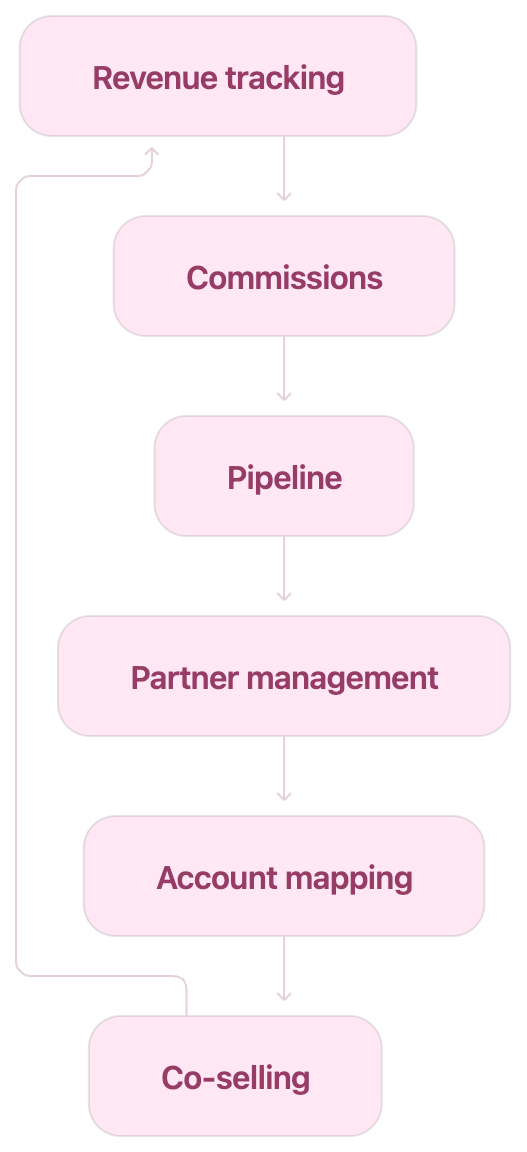
1. Build and segment the partner ecosystem
The platform holds partner profiles: type (referral, reseller, technology, service, strategic), tier, territory, capability, and onboarding status. Segmentation lets the team treat a high-volume referral partner differently from a co-sell partner working the same three enterprise accounts.
2. Connect CRM accounts and opportunities
The platform syncs bidirectionally with HubSpot or Salesforce, respecting permissions and data-freshness rules so that the CRM stays the system of record for customer and pipeline data while partner context becomes visible on the account and the deal.
3. Map partners to targets and open deals
Account overlap gets checked at every level that matters: prospects, existing customers, active opportunities, and expansion accounts. This is where the platform answers the question sales actually asks: "does anyone already have a relationship here?"
4. Turn overlap into co-sell action
Overlap becomes useful the moment someone acts on it: requesting an introduction, accepting a referral, asking a partner to validate a deal or add influence, building a shared account plan, or assigning a clear next step and owner.
5. Track sourced and influenced revenue
The platform applies attribution rules and time windows to decide what counts as partner-sourced versus partner-influenced. One deal can have multiple partner touchpoints; the goal of good attribution is consistent governance, not claiming every touch a partner ever made near a deal.
6. Calculate commissions and learn from outcomes
Closed-won revenue connects to commission rules automatically, and the resulting data — which partners and account types actually converted — feeds back into how the team selects, enables, and prioritizes partners for the next cycle.
Picture this less as a linear checklist and more as a flywheel: recruiting by overlap surfaces new account overlap, which drives co-sell activity, which produces tracked partner revenue. That revenue data then feeds back into who gets recruited and prioritized next: partners and account types that produced real pipeline get more attention and investment, while low-yield relationships get less. Each turn compounds the one before it, because the recruiting decision is informed by the last cycle's outcome instead of a fresh guess. OneStock's nine-month partner-led transformation is a real-world example of this loop taking hold inside one program.
Steps 3 and 4 above depend on a team's ability to actually recognize opportunities in its partner ecosystem in the first place, and steps 5 and 6 only work reliably inside a broader discipline for managing a partner ecosystem from strategy to execution.
Partner Revenue Platform vs PRM, CRM, Account Mapping, and Point Solutions
A partner revenue platform does not discard the operational capabilities associated with a PRM; it connects them to account intelligence, sales execution, revenue attribution, and commissions. A CRM remains the system of record for sales pipeline, while account mapping tools and partner directories solve narrower parts of the overall workflow.
Comparison table
What this table shows: where each type of tool is strong, and where the connected motion of a partner revenue platform picks up what a single-purpose tool leaves off.
Does a Partner Revenue Platform replace your CRM?
No. Your CRM stays the system of record for customer and sales pipeline data. A partner revenue platform adds the layer on top: partner context, account overlap, co-sell actions, attribution, and commissions, connected back into the CRM so sales sees it where they already work.
Does it replace account-mapping software?
Yes, account mapping is included, and it's a core engine inside a partner revenue platform, but finding overlap is only the first step. A standalone mapping tool can tell a team where the overlap sits; a partner revenue platform connects that overlap to a next action, revenue measurement, and eventually a commission.
Is a Partner Revenue Platform just a modern PRM?
It includes the operational foundation buyers associate with a PRM: partner onboarding, a portal, deal registration, commission tracking. What changes is the organizing principle. A PRM is built to manage partner relationships. A partner revenue platform is built around one outcome: turning the ecosystem into pipeline and revenue that sales, partnerships, and finance can all see and trust. If time-to-revenue is the deciding factor in your evaluation, see how partner platforms compare on time to revenue; if the CRM boundary is the open question, see what your CRM should handle in a partner revenue stack.
Why Partner Revenue Matters for B2B Growth
Partner revenue matters because it expands reach, creates trusted routes into accounts, reduces dependence on cold acquisition, adds implementation or service capacity, and improves customer outcomes. The strategic value comes from coordinating an ecosystem around real customer problems, not from recruiting the largest possible partner list. For the broader case, see why partnerships are critical for B2B growth.
Partnerships extend reach and credibility
A partner who already has trust with a buyer, a foothold in an adjacent category, complementary services, or a relevant integration gives a sales team a lower-friction way into an account than cold outreach ever can. That credibility is borrowed, not built from scratch, and it compounds over the life of the relationship. This is one of the main purposes of B2B partnerships: partner types differ, but each one exists to shorten the distance between a company and a buyer who doesn't yet trust it directly.
Ecosystems create compounding routes to market
Technology partners, referral partners, resellers, service partners, and strategic alliances don't operate in isolation when the ecosystem is coordinated well; a technology integration can create the credibility for a referral, a reseller can extend a footprint a direct sales team could not reach alone, and a service partner can pick up implementation work that keeps a customer healthy after the deal closes. None of these roles is more important than the others on its own. What compounds is the coordination between them, and the advantages of strategic B2B partnerships show up most clearly in market access: a target account with a technology integration, an implementation partner, and a reseller relationship all pointing at it has three separate warm paths in, not just one. Read more on what a partner ecosystem is and why it matters.
Partner-first does not mean direct-sales last
The healthiest framing treats partnerships and direct sales as one revenue team working the same accounts, not as competing channels fighting over the same pipeline. A partner-first approach doesn't mean routing every deal through a partner or deprioritizing direct outbound; it means checking for a warm path before defaulting to cold outreach, and giving the rep a fast, low-friction way to find out whether that path exists. That kind of coordination, not headcount or partner count, is what builds stronger B2B partnerships over time. See build a partner-first growth motion for a fuller argument against treating this as a zero-sum choice.
Examples of ecosystem strategy in practice
- OneStock's nine-month partner-led transformation shows what shifting toward a partner-led motion looks like in a real program.
- Vena's one-team ecosystem approach illustrates treating partnerships and sales as a single operating unit rather than separate functions.
- A multi-party partner ecosystem blueprint is a useful example of coordinating many partner types around one outcome, even outside a typical SaaS context.
For a retrospective look at how the industry expected priorities to shift, see how partnership priorities were expected to evolve — treat this as a historical snapshot rather than current research.
What Metrics Should a Partner Revenue Platform Track?
A partner revenue platform should track both revenue outcomes and the leading signals that produce them. At minimum, the scorecard should separate sourced and influenced pipeline, show conversion and velocity, quantify program economics, and expose partner activation and engagement.
The core distinction underneath most of this scorecard is between partner-sourced and partner-influenced revenue. Partner-sourced revenue comes from a deal a partner originated. Partner-influenced revenue comes from a deal the partner helped move forward without originating it, such as a validation call or a warm introduction mid-cycle. Both matter, and both require attribution rules the team agrees on in advance so the numbers hold up under scrutiny.
Revenue and pipeline metrics
- Partner-sourced pipeline and closed-won revenue
- Partner-influenced pipeline and closed-won revenue
- Pipeline coverage and forecast by partner, type, region, and program
- Average deal size with and without partner involvement
- Win rate with and without partner involvement
- Sales-cycle length with and without partner involvement
Partner activation and execution metrics
- Time to first referral, registered deal, or co-sell action
- Active partner rate
- Account overlaps identified and acted upon
- Warm introductions requested, accepted, and converted
- Co-sell opportunities and stage progression
- Deal-registration response time and conflict rate
Program economics and partner value
- Partner acquisition and enablement cost
- Revenue and gross margin by partner
- Commission cost and payout accuracy
- Partner lifetime value and broader partner economics
- Incremental revenue, not merely attributed revenue
Attribution rules that leadership can trust
Every program needs a shared, written definition of "sourced" and "influenced," including contribution windows, what counts as evidence of influence, and how multi-partner deals get handled. Without that written definition, every quarterly business review turns into a negotiation: partnerships claims a wider set of deals than finance or sales are willing to credit, and the resulting distrust makes leadership discount the numbers even when the underlying work was real.
Publishing these definitions beside every dashboard, in plain language, is what turns a partner metrics report from a debate into a source of trust. It also protects the partner team from its own worst instinct, which is to claim every touch a partner ever made near a deal instead of the touches that can actually be evidenced. A narrower, defensible number that survives scrutiny is worth more than a larger one that does not.
Related reading: measure partnership value beyond closed revenue and compare Partner Lifetime Value and Partner Economics.
When Does Your Company Need a Partner Revenue Platform?
A company needs a partner revenue platform when partners are expected to influence pipeline, but the team cannot consistently see account overlap, coordinate with sales, trace partner involvement, or calculate rewards without manual work.
Strong buying signals
- Partner data, CRM data, co-sell conversations, and commission calculations live in separate tools.
- Sales asks which partners can help on a target account, but the answer depends on one partner manager's memory.
- The program reports logins, meetings, or registrations, but can't prove pipeline and revenue.
- Partner-influenced deals disappear because only the original referral source ever gets recorded.
- Channel conflict or duplicate deal ownership slows sales execution.
- Commission reconciliation creates delays, errors, or disputes with partners.
- The team is adding partners or geographies faster than its manual processes can keep up with.
When a lighter system may still be enough
An early-stage program with a handful of partners and no repeatable deal flow probably doesn't need a full platform yet. What it needs first is a defined ideal partner profile, a clear mutual value proposition, a named owner, a basic process, and one success metric everyone agrees on. A spreadsheet and a shared CRM view can carry a program through that early stage perfectly well.
The signal to look for is not partner count but repeatability: once the same basic motion (identify overlap, request an introduction, register a deal, track it to close) is happening often enough that a spreadsheet can't keep up, or often enough that no one person can hold the whole picture in their head, that's the point where the manual process starts costing more in missed pipeline than a platform would cost in tooling. Getting the fundamentals in place first is what makes a platform worth adopting later, and being honest about that sequencing is more useful to a partnerships leader evaluating options than a premature pitch.
How to Choose a Partner Revenue Platform
Evaluate a partner revenue platform against the full revenue motion and your existing stack, not against a feature checklist in isolation. At a minimum, look for a platform that manages the full partner lifecycle, maps partners to real target accounts and open opportunities, turns overlap into a trackable action, separates sourced from influenced revenue with transparent rules, detects conflict early, automates commissions, and integrates natively with the CRM your sales team already uses. A strong platform should help the partner team operate the program, help sales act on partner intelligence, and help leadership verify commercial impact.
It's worth separating vendor demos into two conversations: one about whether the platform can run your program day to day, and a second, more important one about whether a rep who rarely works directly inside the platform can still get value from it inside their CRM. A platform that partnerships uses but sales cannot access in its normal workflow will produce the same disconnected outcome as no platform at all, just with better-organized partner records.
There's no universal timeline for implementation: it depends on how clean your CRM data is, how complex your program and commission rules are, and how many integrations and permission levels you need to set up. Ask any vendor for their typical time to the first useful revenue signal rather than accepting a flat number, since that first signal is a better indicator of real momentum than a generic "go-live" date.
Evaluation checklist
- Can it manage multiple partner types, tiers, territories, onboarding paths, and enablement?
- Can it map partners against prospects, customers, target accounts, and live opportunities?
- Can users turn overlap into an assigned, trackable co-sell action?
- Can it distinguish partner-sourced from partner-influenced revenue?
- Does it provide transparent attribution rules and an audit trail?
- Can it detect conflicts and clarify ownership before they damage trust?
- Can it calculate complex or multi-tier commissions from closed revenue?
- Does it integrate bidirectionally with the CRM and relevant billing systems?
- Can sales use partner intelligence without adopting a disconnected workflow?
- How quickly can the team implement it, activate partners, and reach the first measurable outcome?
- What permissions, privacy controls, and data-governance options protect account information?
- Can dashboards report outcomes by partner, motion, program, region, and period?
Questions to ask vendors in a demo
- "Show us how a target account becomes a partner introduction and a tracked opportunity."
- "Show us how the platform records influence when the partner didn't source the deal."
- "What happens when two partners, or direct sales and a partner, claim the same opportunity?"
- "Which actions happen in the CRM, and which happen in your platform?"
- "How are commission rules changed, approved, and audited?"
- "What data must partners share for account mapping, and who can see it?"
- "What is the typical path from implementation to the first useful revenue signal?"
Use these 12 questions in your Kiflo demo → Book a personalized demo
How Kiflo Connects the Partner Ecosystem to Pipeline
Kiflo brings partner management, account mapping, co-selling, revenue tracking, and commission automation together so partnership and sales teams can work the same target accounts and measure the revenue partners help create.
Start with the accounts that matter
Kiflo's workflow starts with your target accounts, not a generic partner directory: bring your target accounts, and see which partners can help you win them. From there, the platform surfaces the partners with real overlap, so partnerships spends time on the relationships most likely to move a specific deal, not the ones easiest to log into the portal.
Keep partner operations connected to revenue action
Onboarding, partner assets, deal registration, conflict management, directory leads, and day-to-day partner engagement all remain part of Kiflo. What changes is that each of them feeds a revenue outcome instead of sitting in its own silo: an onboarded partner becomes an active account-overlap source, a directory lead becomes a trackable opportunity, and a registered deal becomes a line in the partner-sourced revenue report.
Work with the systems the revenue team already uses
Kiflo integrates natively with HubSpot and Salesforce, connects to other CRMs through Zapier or API, and syncs revenue data from Stripe and Chargebee to support commission calculations.
Proof points
Trusted by more than 450 partnership teams. Kiflo helps growing partnership teams connect partner operations to measurable revenue. Sellsy reported doubling indirect-sales revenue in its first year on Kiflo, and Kiflo's G2 profile includes more than 100 five-star reviews at a 4.8/5 rating.
"In the first year, we doubled indirect sales revenue." — Mathieu Arles-Dufour, Head of Partnerships, Sellsy
Kiflo's shift from managing partners to a full Partner Revenue Platform reflects hundreds of conversations with partnership leaders across its customer base, not a single formal survey. OneStock launched its first partner-delivered project within nine months of starting that shift with Kiflo.
When partners do get pulled into a deal, the industry evidence backs up the effort: LeanData's published case study with Crossbeam reports a 15% year-over-year increase in partner-sourced revenue, partner-influenced revenue growing from 3% to 80% of total revenue, and 24% higher annual contract values on partner-influenced deals versus non-influenced deals. Those are LeanData's own published results, not a Kiflo-measured outcome.
Conversion block
Your next pipeline source may already be in your partner ecosystem.
Kiflo helps you find partner overlap, coordinate co-sell action, and track the revenue your partners help create, from target account to commission.
Book a personalized demo: Bring your target accounts. We'll map your fastest path to partner revenue.
Want the category story first? Read why Kiflo evolved into a Partner Revenue Platform.


