


Co-Selling: How to Turn Partner Relationships Into Revenue
Co-selling is a collaborative sales motion in which a company and one or more partners actively work the same customer opportunity together. Unlike a referral, where the partner passes a lead and steps back, co-selling keeps both parties involved. Each side contributes a relationship, expertise, credibility, or a product or service capability needed to advance and close the deal.
A co-selling motion usually begins by identifying shared target accounts or live opportunities, qualifying where a partner can genuinely help, agreeing on customer value and roles, and assigning a specific action such as a warm introduction, joint discovery call, technical validation, or shared account plan. The activity should be tracked against the opportunity so partnership, sales, and revenue teams can see ownership, progress, partner influence, and the resulting revenue. Done well, co-selling turns partner relationships into coordinated pipeline action rather than informal introductions that disappear in email or Slack.
What Is Co-Selling?
A sales motion qualifies as co-selling when the participating companies coordinate around the same customer opportunity, contribute complementary value, and remain actively involved in progressing the deal.
True co-selling normally includes a shared or complementary customer opportunity, active participation from at least two companies, a joint customer-value proposition, agreed roles and ownership, shared actions or coordinated customer engagement, visibility into opportunity progress, and a method for recording partner sourcing or influence.
Co-selling does not require both companies to perform identical sales tasks. One party may provide the customer relationship, another the product, another implementation expertise, and another the purchasing route. What makes it co-selling rather than two separate motions running in parallel is that the parties coordinate around one opportunity with a shared understanding of who does what.
Who participates in a co-sell motion?
A co-sell motion can involve a vendor or SaaS company, a technology partner, a consulting or implementation partner, a reseller or channel partner, a cloud provider or marketplace team, and, internally, a partner manager, an account executive, and Revenue Operations or Partner Revenue Operations. Not every motion involves all of these roles; a technology-alliance co-sell might involve just two companies and two individuals, while a multi-partner enterprise deal can involve several of each.
Microsoft defines co-selling similarly at the program level: as any collaborative engagement across demand creation, sales planning, lead sharing, partner-to-partner selling, and marketplace-led commerce. That framing is specific to Microsoft's own partner program, but it illustrates the same underlying idea: co-selling spans several kinds of joint activity, not one fixed motion.
How Does Co-Selling Work?
Co-selling works by identifying an opportunity where a partner can add meaningful customer value, agreeing on each participant's role, coordinating a specific sales action, and tracking the outcome against the opportunity.
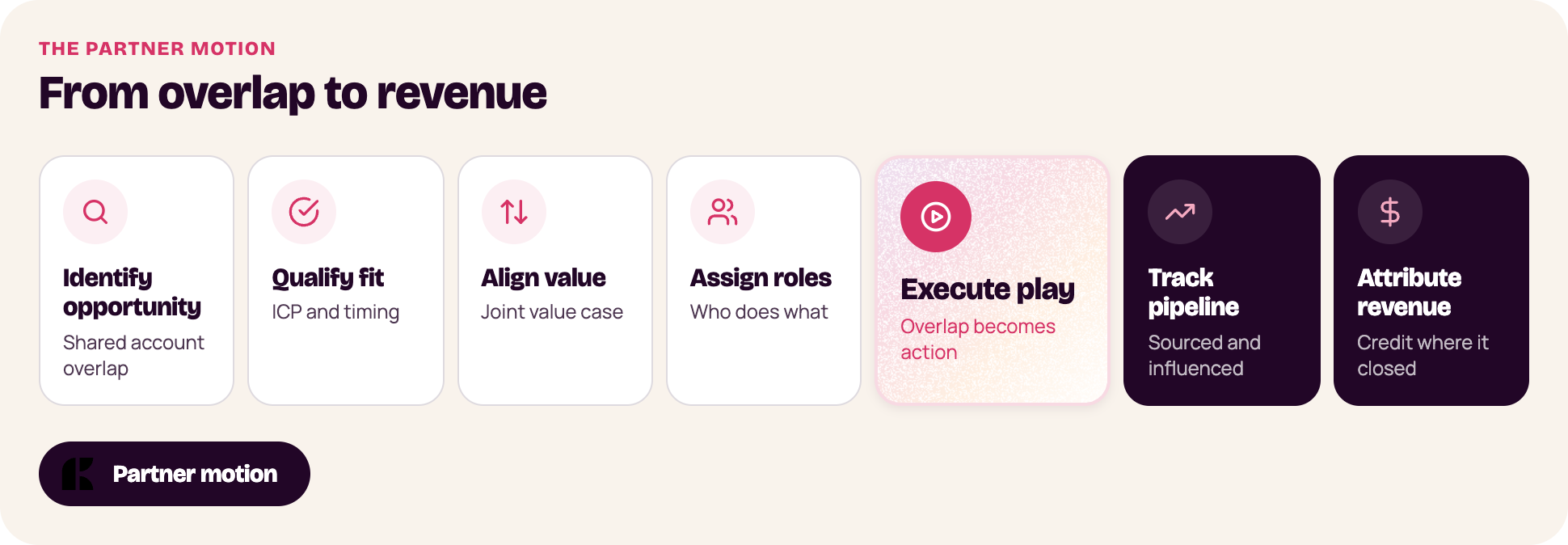
1. Identify a shared or partner-assisted opportunity
Use account mapping, target-account lists, open opportunities, partner referrals, customer requests, integrations, or marketplace signals to find accounts where joint action may be useful.
2. Qualify partner and customer fit
Evaluate the strength and recency of the partner relationship, ideal-customer-profile fit, complementarity of the solutions or services, opportunity timing and stage, partner willingness and capacity, and the value the joint motion creates for the customer.
3. Agree on the joint value proposition
Define why the customer benefits from both parties working together. Avoid building the motion around what each partner wants without first establishing why the combination is useful to the buyer; a co-sell play built on internal convenience rather than customer value tends to fall apart under scrutiny.
4. Define roles and rules of engagement
Agree on who leads the customer relationship, who requests or makes the introduction, who owns discovery, demonstration, technical validation, implementation, and follow-up, how information will be shared, how channel conflict will be resolved, and how sourcing and influence will be credited.
5. Execute a specific co-sell play
Examples include a warm introduction, a joint discovery call, a shared account plan, partner influence on an active opportunity, technical validation, an integrated solution demonstration, marketplace procurement support, or a joint expansion motion inside a shared customer.
6. Track the action and revenue outcome
Record the opportunity and account, the partner and internal owners, the requested action, its status and deadline, partner source or influence, opportunity progression, closed revenue, and any commission or incentive where applicable.
Account overlap is only the signal. Co-selling is the owned action taken on that signal, and revenue attribution shows whether the action produced a result.
What Are the Main Types of Co-Selling?
Co-selling is a category of coordinated sales motions, not one fixed program structure. Five models cover most of what teams mean by the term.
Technology-alliance co-selling
Two technology companies jointly sell complementary or integrated solutions to a shared customer, usually anchored around a product integration.
Services and implementation-partner co-selling
A software vendor works with a consultancy, agency, managed service provider, or systems integrator that contributes expertise, delivery capacity, and an existing customer relationship.
Cloud-provider and marketplace co-selling
A company works with AWS, Microsoft, Google Cloud, or another cloud ecosystem to identify opportunities, coordinate with cloud sellers, and potentially simplify procurement through a marketplace. This is one prominent model, not the entire category: plenty of co-selling happens between two companies with no cloud marketplace involved at all. Within this model, AWS reports that 80% of partners consider AWS Marketplace an important part of their co-sell strategy, a figure from AWS's own Canalys-commissioned research specific to AWS partners rather than a claim about co-selling generally. Microsoft's co-sell overview describes a comparable model built around demand creation, lead sharing, and marketplace-led commerce within its own partner ecosystem.
Channel-partner co-selling
A vendor and a reseller, referral partner, or regional channel partner jointly pursue an opportunity while sharing defined responsibilities.
Partner-to-partner and multi-partner co-selling
Multiple partners combine products, services, relationships, or routes to market around one customer need. Multi-partner motions require particularly clear ownership and attribution, since more parties touching one opportunity increases the risk of duplicated outreach or disputed credit.
Co-Selling vs. Referrals, Reselling, Cross-Selling, Co-Marketing, and Account Mapping
Co-selling is the coordinated revenue motion in which two or more companies jointly pursue and progress a customer opportunity. Several adjacent terms describe related but distinct activities.
A referral can be the right motion when the partner only needs to make a handoff. When the opportunity requires shared expertise, credibility, or active customer engagement, deeper collaboration may be more effective. See our comparison of co-selling vs. referrals.
What Are the Benefits of Co-Selling?
Co-selling can produce real commercial value, but the benefit comes from a specific mechanism in each case rather than from partnership activity in general.
Warmer access to target accounts. A partner with a credible relationship can create a warmer path into an account than cold outreach alone, because the introduction carries existing trust rather than starting from zero.
Greater buyer trust and context. Partners can contribute customer knowledge, industry expertise, technical credibility, implementation confidence, or an existing trusted relationship that a single vendor may not have on its own.
Stronger and more complete customer solutions. Complementary products and services can address a broader customer problem than either company can solve alone, which is often the actual reason a customer engages with both parties rather than one.
More efficient deal progression. The right partner can help with introductions, stakeholder access, technical validation, procurement, and internal consensus. Co-selling does not always shorten the sales cycle; it can when the partner removes a genuine bottleneck, such as stakeholder access or technical proof, and it may add little when the partner's contribution isn't relevant to what's actually slowing the deal down.
Expansion into new markets and accounts. Partners can add regional presence, vertical expertise, customer access, or a route to market that the company does not have directly.
More measurable partner contribution. When co-sell actions are connected to opportunities, teams can distinguish partner-sourced and partner-influenced revenue instead of reporting only partner activity, such as logins or meetings held.
How Do You Build a Successful Co-Selling Program?
Building a successful co-selling program means defining the motion, aligning partner and sales priorities, and starting narrow before scaling.
Choose partners based on account and solution fit
Prioritize partners that reach relevant target accounts, contribute complementary value, and have the motivation and operational capacity to collaborate, rather than the partners easiest to sign.
Define the co-sell motion before selecting tools
Choose the model or models the program will support, such as technology alliances, service partners, channel partners, or cloud providers, before evaluating software built around a specific one.
Align ideal customers and the joint value proposition
Document shared ideal-customer characteristics, target accounts and relevant opportunity stages, the customer problems the combination solves, the roles each partner plays, and the reasons the customer should engage both companies.
Establish rules of engagement
Cover account ownership, communication, data access, deal registration, conflict resolution, attribution, and compensation before the first live opportunity, not after a dispute.
Get sales involved before opportunities are handed over
Partnerships should not build a list of co-sell accounts in isolation and expect sales to execute it later. Sales should help qualify accounts, define useful partner context, and own the customer-facing next action.
Equip both sides to sell the combined value
Provide joint messaging, customer examples, qualification questions, integration or implementation context, objection handling, and named contacts for support.
Start with a focused pilot
Begin with a small number of strategically aligned partners, a defined target-account segment, one or two repeatable co-sell plays, clear owners and response times, and a short list of leading and revenue metrics.
Review and improve the motion
Use monthly opportunity reviews and quarterly partner reviews to identify stalled actions, data gaps, attribution disagreements, and partners that consistently create value.
How Should Partner, Sales, and Revenue Operations Teams Work Together?
Co-selling works when partnerships, sales, Revenue Operations, the partner seller, and marketing each own a distinct, non-overlapping part of the motion.
Sales representatives participate when the partner context is relevant to accounts they already care about, the requested action is specific, ownership is clear, and the activity is visible in the CRM workflow they already use. A rep who has to leave their CRM to check a separate partner dashboard, decode a vague request, or figure out who owns the follow-up will deprioritize the co-sell motion regardless of how good the underlying partner relationship is.
Why Do Co-Selling Programs Fail?
Co-selling programs tend to fail for operational reasons that show up repeatedly across otherwise well-intentioned initiatives.
Partner overlap is treated as the outcome
A list of shared accounts creates no revenue until the team qualifies the relationship and initiates a specific action.
Sales cannot see which partner can help
Partner knowledge remains inside a partnership tool, spreadsheet, or partner manager's head instead of appearing on the account or opportunity sales is working.
The request is vague
"Can you help with this account?" is less actionable than requesting a named introduction, customer reference, technical validation, or joint call.
Roles and deadlines are missing
An opportunity without an internal owner, partner owner, next action, and deadline is likely to stall.
Sales incentives work against collaboration
If representatives lose credit, control, or compensation when a partner participates, the co-sell program will struggle regardless of the technology behind it.
Account and relationship data is unreliable
Outdated opportunities, weak relationship claims, duplicate accounts, and missing context produce false positives that erode trust in the whole motion.
Channel conflict is resolved too late
Ownership and rules need to be defined before multiple sellers contact the same customer, not after two people have already reached out.
Partner influence is not attributed
If the reporting system counts only partner-sourced deals, partners that materially influence existing opportunities may appear less valuable than they are, which can discourage the exact collaboration the program needs.
Activity is split across disconnected tools
Introductions in email, tasks in spreadsheets, opportunities in the CRM, and partner data in another system make the motion difficult to manage and nearly impossible to measure consistently.
How Do You Measure Co-Selling Success?
Measure co-selling across coverage, activation, pipeline, and revenue. A large number of partner overlaps is not a success if few become owned actions, and a high number of introductions is not a success if their pipeline and revenue outcomes remain invisible.
Four formulas are worth tracking directly: overlap-to-action rate (qualified overlaps with an initiated co-sell action divided by qualified overlaps), introduction completion rate (completed introductions divided by introduction requests), co-sell win rate (closed-won co-sell opportunities divided by closed co-sell opportunities), and attribution completeness (co-sell opportunities with recorded partner source or influence divided by total co-sell opportunities).
Sourced and influenced revenue are different, and conflating them undermines trust in the numbers. A sourced deal originates through the partner. An influenced deal already existed, but the partner contributed meaningfully to its progression or outcome. Reporting only sourced revenue understates the value of partners who work deals sales already found.
When Do You Need Co-Selling Software?
Email, spreadsheets, and CRM notes may support a small, occasional co-sell motion. Purpose-built software becomes useful once several partners are involved, account and opportunity data changes frequently, sales needs partner context inside the CRM, introduction and influence requests need owners and statuses, multiple teams need the same view of the opportunity, channel conflict and access permissions need formal controls, partner-sourced and partner-influenced revenue must be reported consistently, or commissions and incentives depend on what closes.
The right co-selling software should connect account discovery, partner action, opportunity ownership, CRM visibility, attribution, and revenue rather than treating each as a separate workflow.
See how Kiflo helps partnership and sales teams turn partner overlap into owned, trackable co-sell action. Explore Co-Selling Software
How Does Kiflo Turn Partner Influence Into Co-Sell Action?
Kiflo connects co-selling to the wider partner revenue motion, so partner influence turns into a tracked outcome instead of an informal favor.
Find the relevant partner on the account
Kiflo maps partners against target accounts and open opportunities so sales can see where a partner may provide access, credibility, or context.
Turn overlap into a defined action
Teams can create and track warm introductions, referrals, partner-influence requests, and shared deal actions with owners and statuses.
Keep partner context visible to sales
Co-sell activity connects to HubSpot and Salesforce, so representatives can use partner information in the systems where they already manage opportunities.
Track sourcing, influence, and revenue
Co-sell actions tie to partner-sourced and partner-influenced pipeline and revenue, and what closes connects to relevant commission workflows.
Connect the full partner revenue motion
Co-selling sits as the action stage between account mapping and revenue tracking: Partner management, then Account mapping, then Co-selling, then Revenue tracking, then Commissions, then Pipeline. Co-selling isn't treated as an isolated feature inside Kiflo; it's one stage in the broader Partner Revenue Platform.
Kiflo in practice
Rotageek's experience shows what this handoff looks like day to day. "Kiflo's integration with our CRM is very convenient. After we accept a deal in Kiflo, it is automatically sent to our CRM pipeline so we can see all our opportunities in both places," said Travis Fish, Head of Partnerships at Rotageek. Before formalizing its program, Rotageek had found that 60% of its leads were already coming from indirect sources, and it grew its partner network to 30 partners within a few months of putting Kiflo in place. Read the Rotageek success story. These figures describe Rotageek's specific experience, not a guaranteed outcome for every program.
More than 450 partnership teams currently run their programs on Kiflo, which is rated 4.8 out of 5 on G2 with over 100 five-star reviews for ease of use and support.
Turn Partner Relationships Into a Repeatable Co-Sell Motion
Co-selling works when partner context becomes a clear, owned action on a live account. Identifying overlap or exchanging occasional introductions is not enough. Teams need to agree on the customer value, assign responsibilities, coordinate the next action, and connect each partner contribution to pipeline and revenue.
Start with a focused group of partners and accounts that sales already wants to win. As the motion grows, connect account mapping, co-sell activity, CRM visibility, attribution, and revenue tracking so every team can see what happens next and what partners ultimately help create.
Kiflo brings those stages together in one connected partner revenue motion.
Bring a live opportunity. See which partner can help and how Kiflo turns that support into a visible, owned, and trackable co-sell action.

